About me
I’m a third-generation pianist in my family. It goes back to my great-grandparents, Gertrude Lark and Edward Menninger, who met as piano students under a shared instructor, Carrie S. Koch, and performed together at her recitals at the Detroit Conservatory.
I started lessons in 1988, down the street from our home, at a music store in Canton, Michigan that I didn’t know at the time was something of a local institution.
Arnoldt Williams Music
John Williams had owned the store on Canton Center Road since 1971 — by the time I showed up it had one of the largest inventories of synthesizers, sheet music, and grand pianos I’d ever seen, something like half of a Guitar Center today. Arnoldt Williams used to set up and service Bob Seger and the Silver Bullet Band’s equipment before each of their tours, and Seger was photographed wearing the store’s shirt. I had no idea about any of that at twelve years old, when I grabbed a piece of sheet music off the sales shelf before a lesson and started picking out the opening of the Mozart K. 466 concerto. John Williams himself walked over, interested, and sat down and played sections of it for me. I mentioned it to my teacher afterward, who just said: “John played for you?”
My first lesson was June 27, 1988, and I studied there until about the summer of 1990.
Dimas Caraballo (1988–1990, Canton, Michigan)
Dimas was working on his graduate degree while teaching lessons at Arnoldt Williams. He taught me the fundamentals — the early Bastien books, loose-leaf pieces like Sultan’s Caravan, Wheels, a Cossack dance, a Beethoven sonatina in G — through to the last piece I studied with him, Burgmüller’s L’Orage.
Born in Havana, Dimas earned his piano performance degree at the University of Miami under Dr. Rosalina Sackstein, and completed graduate work at the University of Michigan under Louis Nagel, Theodore Lettvin, and Susan Starr. He’s held first-place wins at the Southeast Florida Chopin Competition and the Fort Lauderdale Piano Concerto Competition, among others, and has performed with dance companies including the Netherlands Dance Company and the Dance Theater of Harlem. He still teaches, in Vero Beach, Florida.
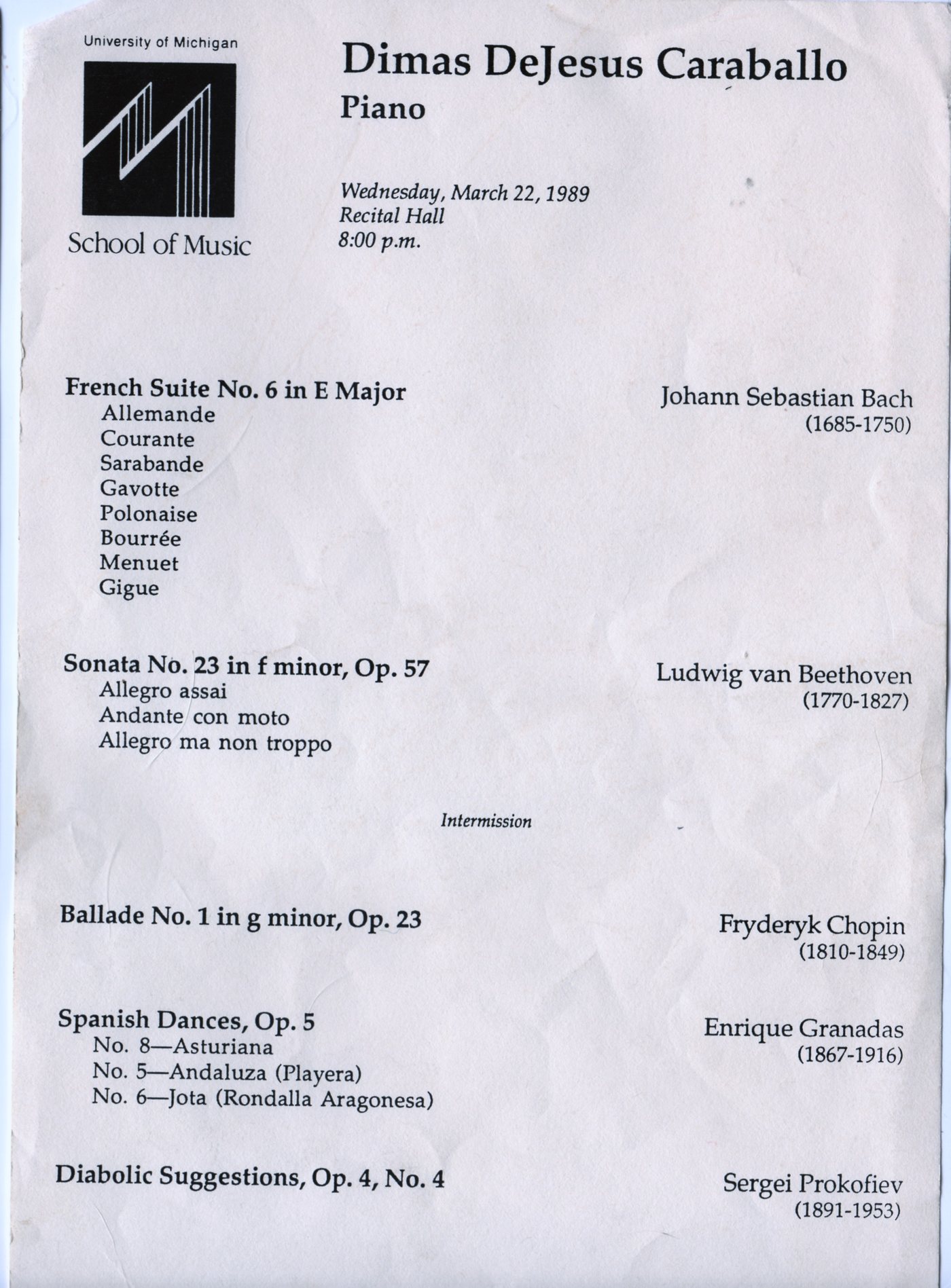
His own graduate recital program, from March 1989, happens to include Beethoven’s Appassionata — the same sonata this library has a growing page about.
Daniel Durand (Phoenix, Arizona, 1990–1992)
When I moved to Arizona, my teacher’s advice was to find someone with a master’s degree in piano. What I found instead, through a chain of recommendations, was Dan Durand — a vocal teacher and choir director who also had a Bösendorfer concert grand in his home, where I studied mostly Baroque and early Classical literature.
Dan wrote a book, Music and Feeling: An Inquiry into the Relationship of Notation and Technique, which argues for a kind of humility in front of the score:
I believe that those depths are best plumbed by interpreters who are humble before the score. I do not believe in the interpreter’s superiority over composers. I do not believe in the shaping of phrases by dynamics controlled by performers. I believe in the refinement of feeling for both the instrument and the music.
He’s skeptical, too, of two things pianists often lean on instead of the score itself:
I do not believe in stylistic imitation by performers for historical purposes. I also do not believe that recordings are worth imitation; they are the product of sound engineers, not musicians.
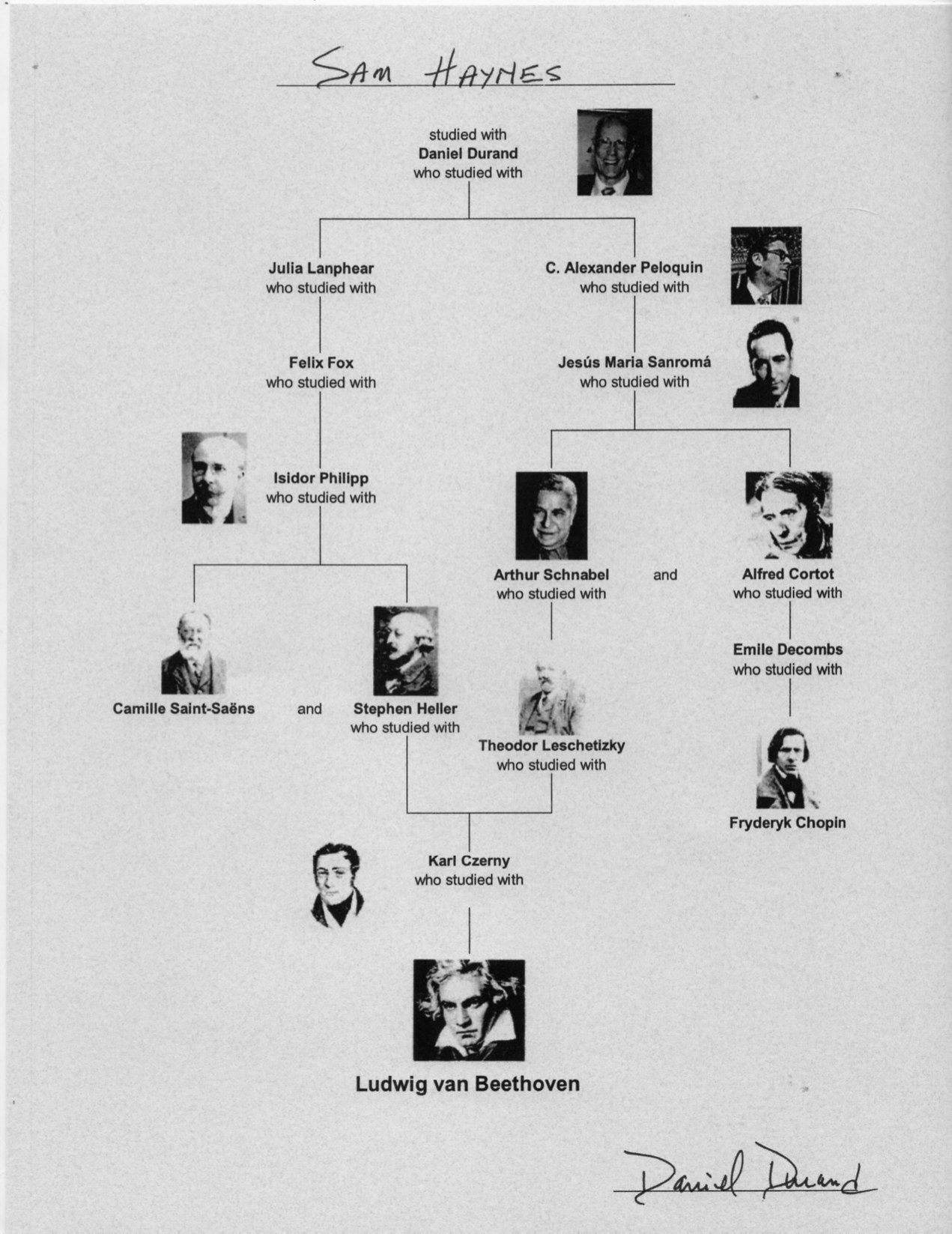
At some point Dan sat down and drew out, by hand, where his own teaching came from — and signed it for me:
Larry Clapp (Phoenix, Arizona, 1992–1997)
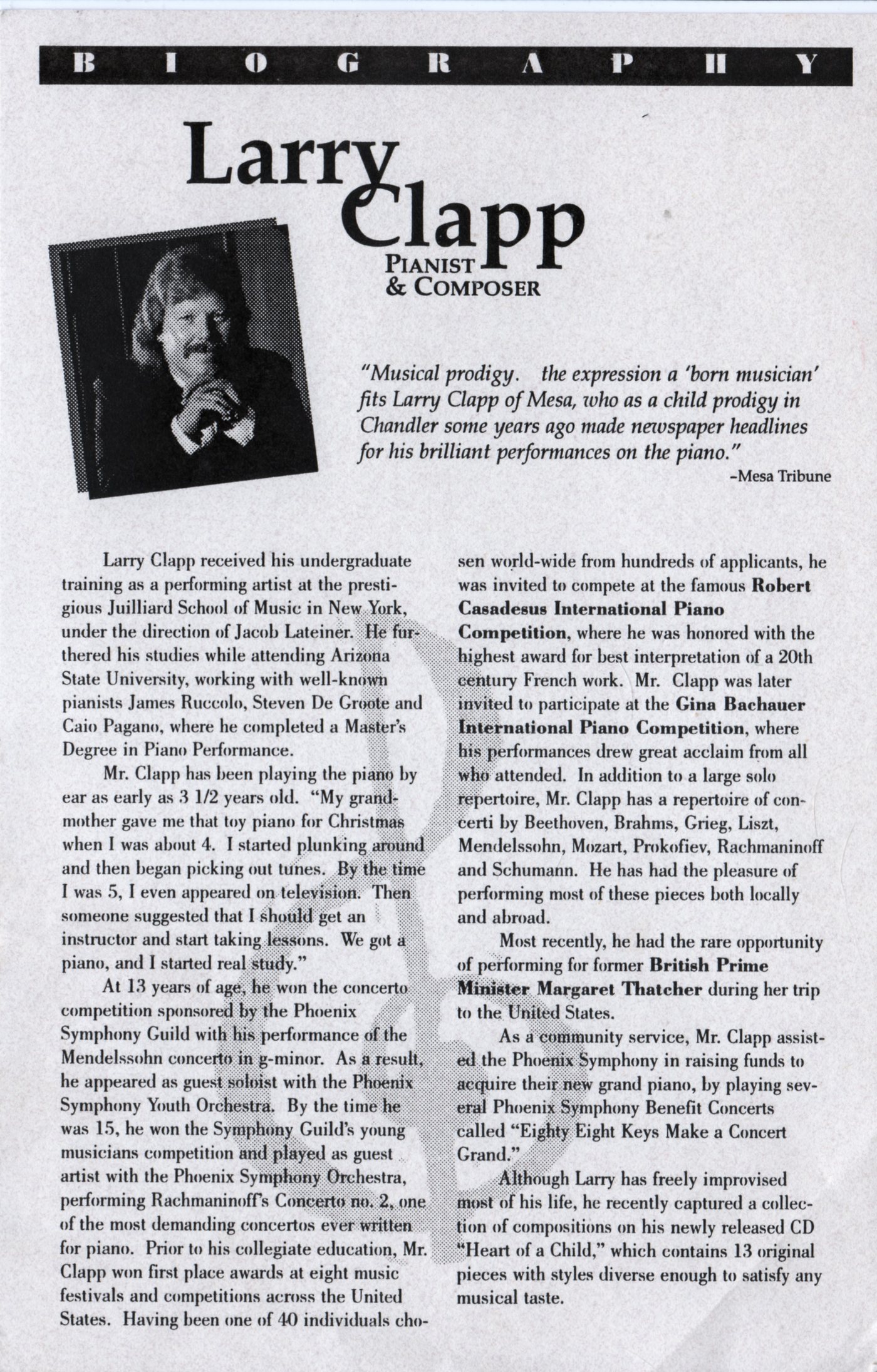
My third teacher. Larry trained at Juilliard under Jacob Lateiner and later at Arizona State University under Steven de Groote and Caio Pagano. He’d also considered Curtis, but only on the condition of studying under Rudolf Serkin. At thirteen he won the Phoenix Symphony Guild’s concerto competition playing Mendelssohn’s G minor concerto; by fifteen he’d appeared as guest soloist with the Phoenix Symphony playing Rachmaninoff’s Second Concerto. He later competed at the Robert Casadesus International Piano Competition and the Gina Bachauer International Piano Competition, and had the unusual experience of performing for Margaret Thatcher during a U.S. visit.
Under Larry I gave several recitals: Chopin’s “Revolutionary” Étude, Op. 10 No. 12 (December 1995); Rachmaninoff’s Moments musicaux and a Chopin waltz (May 1993, Chandler Center for the Arts); and the first movement of Mozart’s K. 466 concerto (December 1994). I also attended NAU’s summer music camp twice (two separate summers), performing Chopin’s C-sharp minor waltz, the “Revolutionary” Étude, and Sibelius’s Romance in D-flat.
Teachers’ teachers
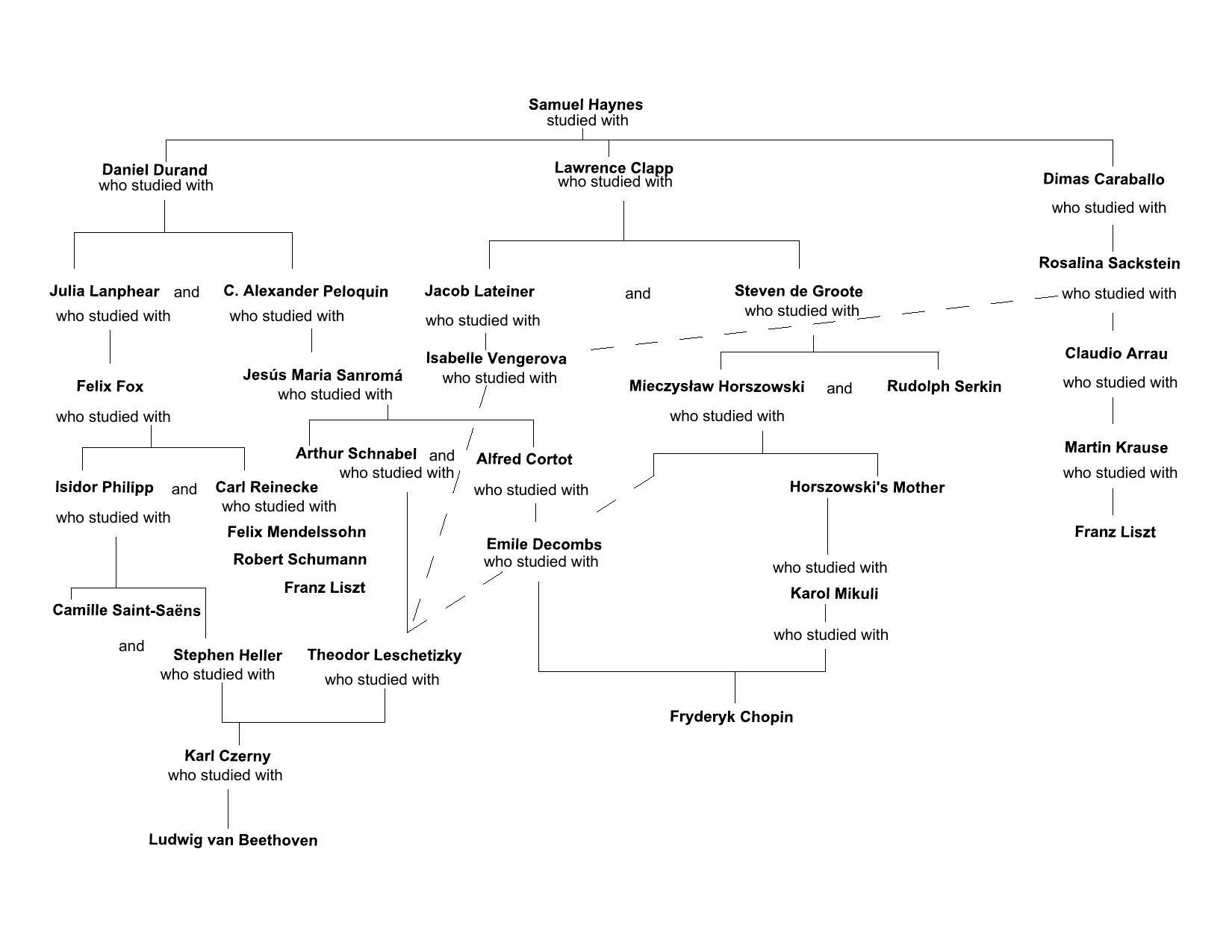
Put the three lines together and they run back to Beethoven, Chopin, and Liszt by three separate routes: through Dan to Czerny and, on a second branch, to Chopin’s pupil Karol Mikuli by way of Leschetizky; through Larry to Rudolf Serkin and Mieczysław Horszowski, both of whom trace to Mikuli’s Chopin line as well; and through Dimas to Claudio Arrau, Martin Krause, and Liszt directly.
A couple of these names are worth a pause.
C. Alexander Peloquin, another of Dan’s teachers, began performing classical piano on his own radio program at eleven and went on to study at the New England Conservatory, where he earned a Boston Symphony Orchestra scholarship to the Berkshire Music Center at Tanglewood. There he served as piano soloist for Leonard Bernstein and his orchestra, and came to know Aaron Copland personally. He was later awarded honorary degrees by institutions including Brown University.
Steven de Groote, Larry’s teacher at ASU, won the Van Cliburn Competition outright in 1977 — the only winner in that competition’s history to also take the prizes for best commissioned work and best chamber music performance. In 1985 he survived a serious plane crash near Phoenix, his lung and aorta punctured, and recovered to resume both flying and performing; CBS News covered it. He died four years later, at thirty-six, of complications from tuberculosis contracted on a visit home to South Africa.
Jacob Lateiner, Larry’s teacher before that, was a Cuban-American pianist who studied with Isabelle Vengerova at Curtis and privately with Arnold Schoenberg. He premiered Elliott Carter’s piano concerto with the Boston Symphony in 1967, shared a Grammy with Jascha Heifetz and Gregor Piatigorsky for a Beethoven recording, and taught at Juilliard from 1966 until his death in 2010. Isabelle Vengerova was also Leonard Bernstein’s piano teacher at Curtis — meaning my line through Larry and Jacob shares a teacher with Bernstein’s own.
Rosalina Sackstein, Dimas’s teacher at the University of Miami, is the gateway on his side of the tree — trained at the Conservatory of Music in Camagüey, Cuba, with a doctorate in pedagogy from the University of Havana, she studied piano herself under Claudio Arrau, Isabelle Vengerova, and Rafael DeSilva, and spent fifty years on the Frost School of Music faculty until her death at ninety-three. Arrau is the direct, two-step link to Liszt on this branch — worth noting since Liszt famously taught without charging his pupils, so an enormous number of pianists can claim some line back to him. Arrau also happens to be the reason Leonard Bernstein met his wife: the two met in 1946 at a party Arrau hosted, where Felicia Montealegre — who had been taking piano lessons from Arrau since arriving in New York two years earlier — was introduced to Bernstein.
A fuller, browsable version of this kind of teacher-to-student mapping — not just my own three lines, but anyone in the library’s research who studied with whom — lives at Schools of Piano.